In Memoriam: Professor Fantu Cheru

Share this post on:

In Memoriam: Professor Fantu Cheru

It is with profound sadness that the Members of the Board of Trustees, and the Executive Management of the Centre for Dialogue, Research and Cooperation announce the passing of Prof. Fantu Cheru, a distinguished member of CDRC’s Board of Trustees since November 2021, and a towering figure in African economic development, political economy, and international relations.

Prof. Fantu Cheru embodied the highest standards of academic excellence. Throughout his illustrious career, he produced a body of rigorously researched, field-defining scholarship that set new benchmarks in the study of structural adjustment, food
security, African agency in global governance, and the political economy of development. His work—marked by intellectual depth, analytical precision, and moral clarity—has shaped generations of scholars, policymakers, and practitioners across the world.

At CDRC, Prof. Fantu Cheru brought not only his exceptional scholarly credentials but also a clarity of purpose and an unwavering commitment to the idea that rigorous research and principled dialogue can contribute meaningfully to peace and development on the African continent. His voice in our deliberations was always one of wisdom, integrity, and generous intellectual engagement. He challenged us to think carefully, to act responsibly, and to remain anchored in the realities of those whose lives our work is meant to serve.

His academic legacy endures. The influence of his ideas—taught in universities, cited in research, and applied in policy—will continue to be felt long after his passing. To his family, his colleagues, his students, and all those who had the privilege of knowing him, we extend our deepest condolences. Prof. Fantu Cheru’s passing leaves a void that will not easily be filled. We are, however, grateful for the years of guidance and friendship he offered to CDRC, and for the mark he has left on everyone who worked alongside him.

May he rest in peace.

Members of the Board of Trustees and Executive Management
Centre for Dialogue, Research and Cooperation (CDRC)

Share this post on:

CDRC and HIRAAD Sign MoU

Share this post on:

CDRC and the Hiraad Public Policy Studies Institute (HIRAAD) signed a Memorandum of Understanding (MoU) on January 5, 2026 to establish a long-term framework for collaboration in research, policy analysis, and strategic dialogue.

Under the agreement, the two non-partisan think tanks will work together on joint research initiatives, evidence-based policy analysis, and knowledge generation focused on peace and security, good governance, socio-economic development, regional integration, and related thematic areas. The partnership also aims to promote inclusive policy dialogue, particularly on issues affecting Ethiopia, the Horn of Africa, and neighboring regions.

The MoU provides for cooperation in organizing joint workshops, seminars, panel discussions, and conferences, as well as exchanging publications, expertise, and analytical products. The institutions also plan to pursue joint funding opportunities to support collaborative research, dialogue, and consultancy activities.

To ensure effective implementation, CDRC and HIRAAD will establish a joint working group responsible for planning, monitoring, and assessing activities, with annual progress reports submitted to both institutions. The agreement emphasizes mutual recognition of contributions, respect for intellectual property rights, and confidentiality in information sharing.

The MoU will be valid for five years from the date of signature and is renewable, reflecting the shared commitment of both institutions to strengthening policy research capacity and fostering constructive dialogue grounded in local and regional perspectives

Share this post on:

CDRC Executive Director Delivers Key Statement on China’s Global Security Initiative

Share this post on:

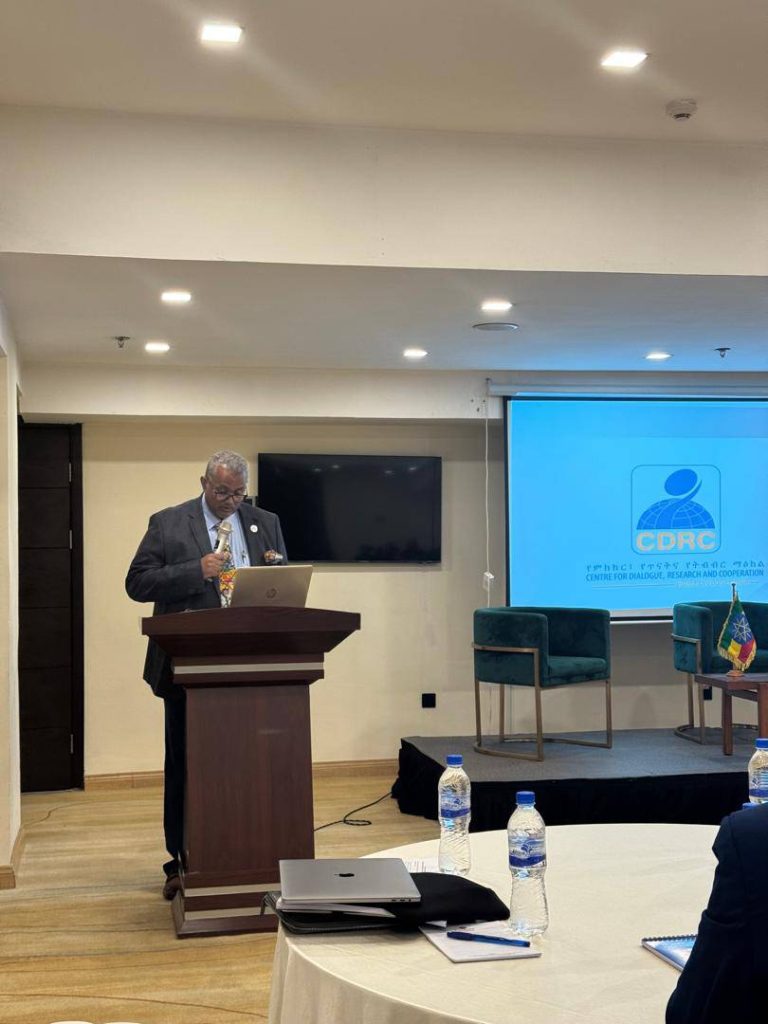
At the seminar “Work Together to Build a Common Security: China and Africa in Action”, held at the African Union Headquarters in Addis Ababa on 4 December 2025, the Executive Director of the Centre for Dialogue, Research and Cooperation (CDRC), Dr. Abdeta Dribssa, presented a detailed and forward-looking assessment of China’s Global Security Initiative (GSI). He described the GSI as an increasingly significant component of contemporary global security discourse and a major external force influencing Africa’s evolving geopolitical and security environment.

Addressing an audience of government officials, diplomats, scholars, and security practitioners, Dr. Abdeta highlighted how the GSI—first announced by China in 2022—has quickly taken shape as a central feature of the shifting international security architecture. He outlined the initiative’s six foundational principles: respect for sovereignty and territorial integrity, adherence to the UN Charter, prioritising dialogue over confrontation, advancing the concept of “indivisible security,” addressing the structural and root causes of conflict, and integrating security with development. These, he noted, form an ambitious blueprint for how China seeks to engage with the world on peace and security matters.

Dr. Abdeta emphasised that the GSI offers both meaningful opportunities and important challenges for African states. On the one hand, the initiative widens the scope of Africa’s diplomatic and security partnerships, provides alternatives to traditional security cooperation frameworks, and links security initiatives with China’s broader portfolio of development financing, infrastructure investment, and emerging digital technologies. These features allow African countries to diversify their partnerships and access resources without governance-related conditionalities often associated with Western security assistance.

On the other hand, Dr. Abdeta cautioned that the GSI’s strong emphasis on state-centric approaches and its reliance on advanced surveillance and digital systems require careful scrutiny. Without robust national regulatory frameworks, transparent procurement processes, and inclusive political dialogue, he warned, African governments risk eroding civic space, deepening technological and financial dependencies, and weakening domestic accountability mechanisms. He stressed that African states must adopt a clear-eyed, strategic approach to engagement, ensuring that cooperation under the GSI aligns with their governance priorities, institutional capacities, and long-term stability objectives.

Turning specifically to the Horn of Africa, Dr. Abdeta described the subregion as a “critical testing ground” for the practical application of the GSI. Its geostrategic importance—linking the Red Sea, Gulf of Aden, and Indo-Pacific maritime corridors—combined with China’s expanding security presence and the competing interests of multiple external actors, make it a laboratory for China’s evolving security doctrine. He noted China’s growing role in maritime security operations, peacekeeping deployments, and selective mediation efforts. Yet he also underscored the risk that an approach overly focused on sovereignty and regime stability may inadvertently stall inclusive political dialogue or overlook the internal drivers of conflict in fragile states.

Dr. Abdeta concluded by calling for greater African agency and strategic autonomy in navigating an increasingly multipolar security landscape. External partnerships, including those with China, he argued, should reinforce—not replace—African-led mechanisms and continental frameworks. The ultimate objective, he insisted, must be to ensure that Africa’s engagement with global powers supports sustainable peace, democratic governance, and resilient state institutions across the continent.

Share this post on:

Dr. Abdeta Beyene, Executive Director of the CDRC, brought a powerful landlocked perspective to the global stage at SAGARMANTHAN

Share this post on:

Dr. Abdeta Beyene, Executive Director of the CDRC, brought a powerful landlocked perspective to the global stage at SAGARMANTHAN – The Great Oceans Dialogue, held October 27- 29, 2025 in Mumbai, India.
Speaking at the session “Sailing into Innovation: Towards a Resilient Maritime Future,” Dr. Abdeta emphasized that maritime innovation must benefit both coastal and inland nations. “The seas are the arteries of global trade — carrying over 80% of the world’s commerce — and how we innovate across this domain will shape the stability and prosperity of nations, coastal or not,” he said.

He stressed that Ethiopia’s future depends on the efficiency, sustainability, and security of its sea access through ports such as Djibouti and Berbera. For landlocked countries, he said, sailing into innovation “does not mean building ships — it means future-proofing economic survival and growth.”

Dr. Abdeta called for smarter, greener trade corridors, stronger regional partnerships in marine research and renewable energy, and the inclusion of landlocked nations in maritime governance, particularly around the Red Sea and Gulf of Aden.

He concluded that maritime resilience must extend beyond coastlines to include hinterlands and inland economies. “It connects the highlands to the harbors and the hinterlands to the high seas,” he said. “Africa’s maritime transformation must leave no nation behind.”

SAGARMANTHAN – The Great Oceans Dialogue, 2025 was organized by The Observer Research Foundation and India’s Ministry of Port, Shipping and Waterways (MoPS&W) as part of India Maritime Week.

Share this post on:

CDRC Journal Launched

Share this post on:

On September 30, 2025, CDRC launched the latest edition of CDRC Perspectives – A Journal of Ideas and Insights on the Horn and Beyond at a well-attended event in Addis Ababa. The program brought together researchers, policymakers, academics, diplomats, and invited guests for an afternoon of reflection on key regional and global issues.
In his opening remarks, Dr. Abdeta Dribssa Beyene, Executive Director of CDRC, described the relaunch of CDRC Perspectives as a milestone for the Centre. He noted that the edition tackles issues ranging from regional integration and peace processes to shifting global dynamics. He emphasized the journal’s role as a platform for rigorous analysis and constructive dialogue, thanked contributors and partners, and invited wider participation in future editions.

The program then featured highlights of the published articles, presented by their authors.

Mr. Endrias Amanuel discussed his two articles Ethiopia and Eritrea: Shared Future Still a Dream, and A Case for Inclusive Multilateral Frameworks on the Red Sea. His analysis underscored the urgent need for renewed dialogue and cooperation between Ethiopia and Eritrea, and the strategic importance of regional frameworks for the Red Sea corridor.

Mr. Wegene Mengistu explored global power realignments in his article BRICS Expansion – A Shift Towards a Cooperative, Inclusive, and Fairer Multilateral World, a Manifestation of a Neo-Realist Global Order, or Both? He highlighted both opportunities and contradictions inherent in BRICS’ growing influence.

Dr. Yidnekachew Mitiku Mekonen addressed global politics in his article President Trump’s Return to Power, Great Power Competition, and Geopolitical Shifts – Implications for the Horn of Africa. He examined how renewed U.S. foreign policy directions might impact the Horn’s fragile geopolitical balance.

Dr. Abdeta Dribssa Beyene, gave highlights of his contributions, Ethiopia’s Access to the Sea, Mapping Somalia’s Peace Processes, and the Re-revitalization of the Intergovernmental Authority on Development (IGAD). His presentations drew keen attention from the audience, particularly on the future of regional integration and governance.

Following the presentations, a Q&A session allowed participants to engage directly with the authors.

Concluding the event, Dr. Abdeta thanked the authors and participants for their engagement and reminded the audience that CDRC Perspectives is an open platform, welcoming future contributions. He noted that the discussions enriched the launch and reaffirmed CDRC’s role as a convening space for dialogue on the Horn of Africa and beyond.

Share this post on:

CDRC Receives Certificate of Appreciation from FDRE Defence War College

Share this post on:
The Centre for Dialogue, Research and Cooperation (CDRC) was honored today, July 21, 2025, with a Certificate of Appreciation from the Federal Democratic Republic of Ethiopia (FDRE) Defence War College. The recognition was awarded in acknowledgment of CDRC’s sustained engagement and its valuable contributions to the College’s training and research programs during the 2024/25 fiscal year.
The certificate was presented during a formal ceremony held at the Defence War College in Addis Ababa. The event was attended by the Minister of Defense, H.E. Aysha Mohammed, alongside senior military officials, faculty members, and guests. Dr. Abdeta Dribssa, Executive Director of CDRC, accepted the award on behalf of the organization.

CDRC and the FDRE Defence War College have maintained a strong institutional partnership since the signing of a Memorandum of Understanding (MoU) in Sept., 2021. Their collaboration in research and training reflects a shared commitment to advancing peace, security, and national development through informed policy engagement and strategic cooperation.

Share this post on:

Executive Director speaks at the at the Global South Economic Forum

Share this post on:

On June 17, 2025, Dr. Abdeta Dribssa, Executive Director of the Centre for Dialogue, Research and Cooperation (CDRC), participated in the Global South Economic Forum (GSEF) held in Abu Dhabi. During a high-level panel on “Integrating Markets through Trade, Investment and Connectivity,” Dr. Abdeta presented a compelling case for Ethiopia’s strategic role in advancing
South-South cooperation.


Dr. Abdeta emphasized Ethiopia’s emerging position as a regional and transcontinental economic hub, underscoring that the country’s integration into platforms such as BRICS signals more than symbolic inclusion—it marks a pivotal opportunity for Ethiopia to serve as an anchor in broader South-South cooperation frameworks. In his remarks, Dr. Abdeta highlighted three
key pillars essential for Ethiopia’s integration into the global South’s economic architecture:


Trade: He described Ethiopia as a growing but under-leveraged trade actor. While still heavily reliant on low-value commodity exports, the country holds the potential to diversify its trade portfolio through deeper engagement with BRICS partners. Strategic investments in standards, logistics, and industrial capacity would be critical to unlocking this potential.

Investment: Dr. Abdeta pointed to the increasing interest of South-South investors—particularly from China, Turkey, and the UAE—in Ethiopia’s economy. However, he emphasized that to attract stable and long-term foreign direct investment (FDI), Ethiopia must undertake key institutional reforms. He also underscored the significance of emerging development finance institutions such as the New Development Bank as vehicles to reduce dependency on Western financial structures.

Connectivity: Ethiopia’s geography—linking the Horn of Africa to the Middle East and the interior of the continent—offers it a natural advantage as a logistical and transport hub. Dr. Abdeta stressed that this potential can only be fully realized through a commitment to peacebuilding, regional integration, and infrastructure development. Beyond the economic dimensions, Dr. Abdeta brought attention to a critical and often overlooked issue: the absence of robust peace infrastructure within the Global South. “Without structured mechanisms for conflict prevention and resolution, the foundations for sustainable development remain fragile,” he warned. He called for increased investment in inclusive governance, platforms for dialogue, and capable regional institutions to manage disputes—arguing that peace must be treated as a prerequisite, not a byproduct, of economic development.


In conclusion, Dr. Abdeta asserted that Ethiopia, despite facing internal challenges, can serve both as a test case and a model for deeper Global South cooperation. Success, however, will depend on the country’s commitment to political stability, far-reaching economic reforms, and active engagement in strategic regional partnerships.

Share this post on:

CDRC Hosts Seminar on Horn of Africa’s Political and Security Trends

Share this post on:

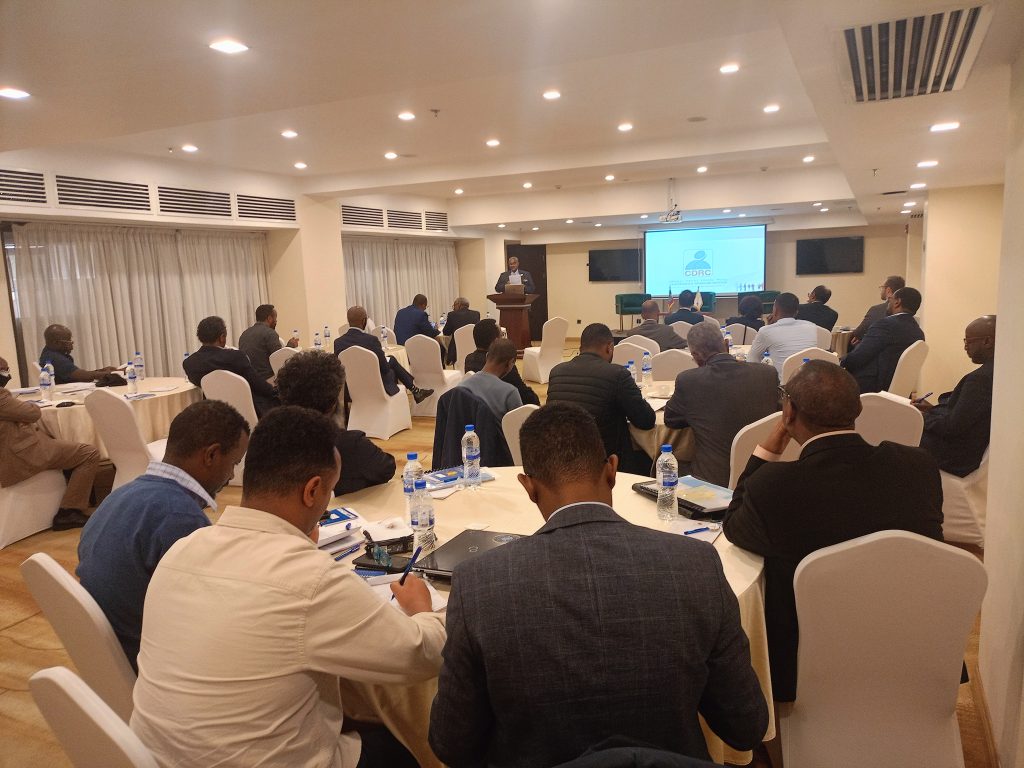
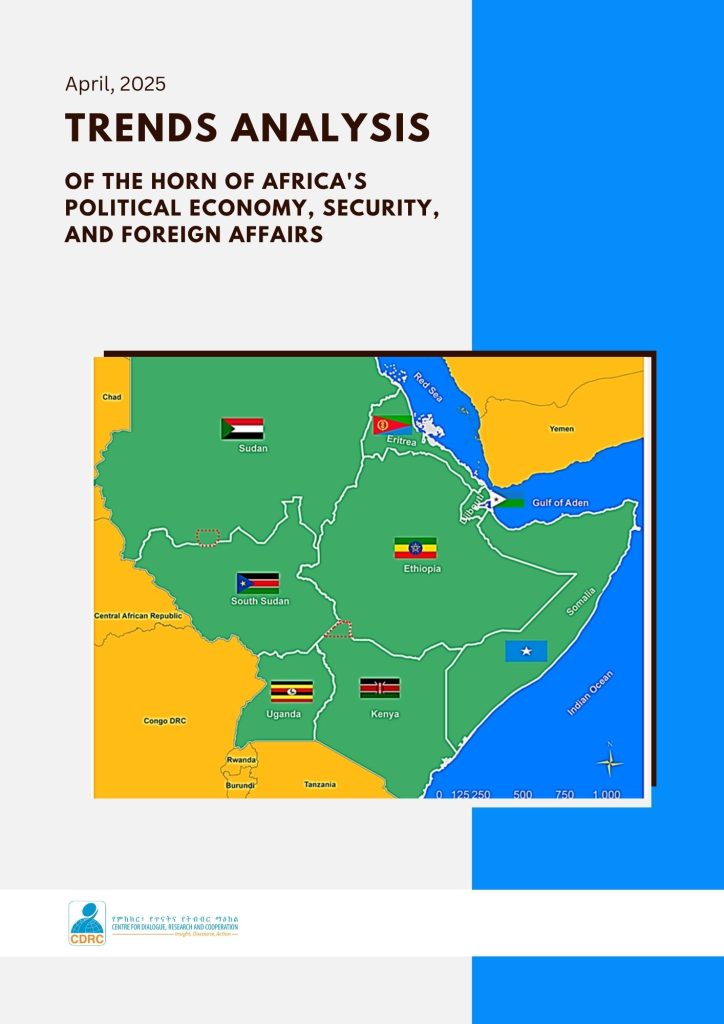
CDRC held a dissemination seminar on June 3, 2025at the Best Western Premier Hotel in Addis Ababa to present its latest research titled “Trends Analysis of the Horn of Africa’s Political Economy, Security, and Foreign Affairs.”

The event opened with welcoming remarks by Dr. Abdeta Dribssa Beyene, Executive Director of CDRC, who reaffirmed the Centre’s ongoing commitment to fostering informed dialogue and evidence-based research to help address the multifaceted challenges facing the Horn of Africa.

Senior researchers Wegene Mengistu and Yidnekachew Mitiku (PhD) presented the main findings of the study, shedding light on critical developments in the region’s political economy, security dynamics, and foreign policy shifts. Their analysis underscored the complexity of regional integration efforts and the pressing need for cooperative strategies to advance peace and sustainable development.

A panel discussion followed, featuring three subject-matter experts who offered thoughtful reflections on the research. They provided a critical review, examined the policy relevance of the findings, and shared ideas on how to make this an enduring process that supports long-term progress in the region.

The seminar concluded with an engaging Q&A session, during which participants exchanged ideas and shared diverse perspectives on the region’s evolving challenges.

Share this post on:

CDRC EXECUTIVE DIRECTOR SPEAKS AT YEREVAN DIALOGUE 2025

Share this post on:

On May 27, 2025, Dr. Abdeta D. Beyene, Executive Director of CDRC, participated as a panelist at the Yerevan Dialogue 2025 in Armenia. Speaking on a session focused on conflict, development, and the global race for critical minerals, he stressed the need for Ethiopia’s growing mineral investments to benefit local communities and support sustainable development.

Referring to Ethiopia’s recent announcement of over $1.6 billion in foreign investments—mainly from Chinese firms—Dr. Abdeta called for community-centered frameworks, transparent governance, and alignment with green industrial policy. His remarks highlighted the importance of managing mineral wealth responsibly to ensure inclusive and conflict-sensitive development

Share this post on:

ETHIOPIAN WOMEN PEACEBUILDERS HOLD MEDIATION WORKSHOP IN KIGALI

Share this post on:

Seven Ethiopian women peace leaders held a mediation and dialogue workshop in Kigali from May 23–25, 2025, as part of the Women Coaching Programme, organized by CDRC. The workshop featured sessions on insider mediation, stakeholder engagement, and peer learning, along with a visit to the Kigali Genocide Memorial.

It also served as a reflective retreat, marking the close of the six-month programme. Participants reviewed key insights and explored continued collaboration with input from Rwandan women peacebuilders. Peacebuilders provided valuable opportunities for cross-country experience sharing and inspiration.

Share this post on: